Troy, Montana
Train DreamsTroy, Montana, is a small town twenty-six miles east of the Eleven-Mile Cutoff Bridge and one of the recurring points through which Robert Grainier experiences the changing world around the railways. It is not presented as a permanent home or a site of decisive settlement, but as a practical and symbolic way station: a place of roads, trains, fuel, bars, public curiosity, and remembered wonders. Troy’s importance lies in this concentration of movement. Grainier passes through it while working, stops there while traveling with Eddie Sauer, and later associates it with a railway spectacle that he remembers imperfectly but never entirely loses.
Setting and Railway Connections
Troy stands within the network of routes that organizes Grainier’s working life. The town is twenty-six miles east of the bridge whose construction helped draw him toward large infrastructural projects. Forty-one days after the attempted killing of a Chinese railroad laborer at the unfinished bridge, the first locomotive crossed the 112-foot span over the 60-foot-deep gorge. The bridge eliminated an eleven-mile curve and reduced the Spokane International Railway’s obligation to maintain that stretch of rails and ties. Troy therefore belongs to a landscape in which small settlements are defined by the larger engineering works passing near them: trestles, rail lines, roads, and the traffic of men and timber.
That regional system extended beyond the immediate bridge. In 1920, Grainier went northwestern Washington to repair the Robinson Gorge Bridge, a structure 208 feet deep and 804 feet wide that carried a railway capable of supporting an engine and two flatcars of logs. Afterward he worked for the Simpson Company, where six-horse teams, a steam donkey, corduroy roads, cable systems, and railroad flatcars moved timber out of the forest. Troy is part of this same infrastructure corridor, a settlement where the forest economy and the railway economy meet without ever becoming identical. The town provides roads and services for travelers, while the railways and logging operations determine the scale and direction of regional life.
A Town of Transit and Practical Friction
Troy appears most concretely in Grainier’s journey with Eddie Sauer to move Claire Thompson from Noxon, Montana, to Sandpoint, Idaho. Grainier traveled with his mares and wagon, while Eddie used a Ford Model T altered by removing its rumble seat and adding a flat cargo bed. They rendezvoused in Troy early in the morning before taking the Bull Lake Road south toward Noxon. Grainier went half a mile ahead because his horses disliked the automobile and also seemed to dislike Eddie, an apparently minor inconvenience that becomes a precise image of competing forms of mobility: animal-powered transport proceeding cautiously in front of a noisy machine.
The journey becomes more difficult at an automobile filling station on the hill east of Troy. Heinz, a German station owner, refused to sell Eddie gasoline. Grainier did not understand the reason at first; he only knew that Eddie came roaring up behind him, horn squawking, nearly stampeding the mares. Grainier walked back to the Ford and warned Eddie not to blast the horn around the horses, explaining that the animals had endured many kinds of commotion but would not tolerate that particular disturbance. Eddie answered that they would have to take the wagon back and buy two or three jugs of fuel because Heinz would not even speak to him. Troy thus becomes a place where technological progress does not create seamless mobility. The automobile’s speed, noise, and dependence on fuel collide with horses, personal antagonism, and the local control of a filling station.
Public Spectacle and Misremembered Modernity
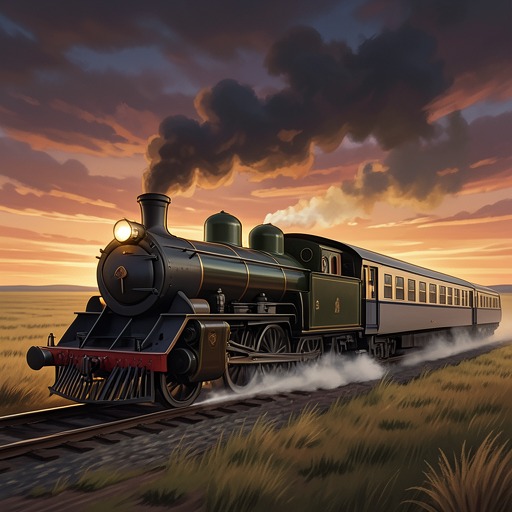
Troy also becomes the setting of one of Grainier’s most vivid late-life memories. He remembered standing on Fourth Street and watching a railway car carrying Elvis Presley, whose private train had stopped for an uncertain reason, perhaps repairs. Troy did not even merit its own station, yet the famous young entertainer’s presence drew townspeople into the street. Grainier came too late from the barbershop to see Presley raise his hand from a window; he learned that detail from the people gathered outside, standing in the late dusk beside the deep bass of the idling diesel and speaking in low voices as they stared toward the train.
The scene transforms an otherwise unremarkable town into a temporary theater of modern celebrity. The train is both vehicle and enclosure, carrying Presley through a place that lacks the institutional importance of a station but briefly becomes important because he is there. The townspeople’s stillness and subdued speech contrast with the machine’s heavy idling, while the young man inside the car is rendered as distant, elevated, and solitary. Troy’s social scale is exposed by the encounter: a small town can become an audience gathered around a passing mystery, while the railway makes that mystery visible and immediately unreachable.
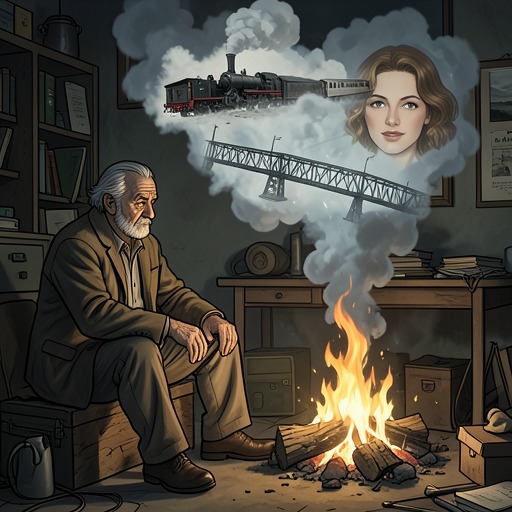
Grainier’s memory of the episode is deliberately unstable. Later in life he became certain that the day he saw the World’s Fattest Man in a traveling trailer was the same day he stood in Troy watching Presley’s train, although the chronology of his past had become confused. The uncertainty does not erase Troy’s significance; it shows how the town has entered Grainier’s private arrangement of historical wonders. He also remembered seeing a wonder horse and a wolf-boy and flying in a biplane in 1927. His life story began with an unremembered train ride and ended, in his own retrospective formulation, with him standing outside a train containing Elvis Presley. Troy therefore occupies the final edge of a life structured by transit and astonishment.
Ethnic and Regional Historical Context
Troy exists within a region marked by forced movement as well as voluntary travel. Grainier’s earliest memory was of the mass deportation of more than a hundred Chinese families from Fry, where men carrying axes, pistols, and shotguns watched them board three flatcars. Many of those displaced people eventually ended up about thirty miles west, between Troy and Libby, in a place called China Basin. By the time Grainier worked on bridges, that community had dispersed, and only a few Chinese residents remained in the surrounding area. The later attempted killing of a Chinese railroad laborer at the unfinished bridge reveals how Troy’s apparently ordinary railway world is connected to a history of racialized exclusion and violence.
The town’s proximity to China Basin also places it within a landscape where railroad expansion, settlement, and ethnic displacement overlap. The railway is a means of connection for workers and travelers, but it is also the mechanism by which families are removed and labor is organized. Troy is not given a single political event of its own in the supplied narrative; its historical force comes from its position within this broader regional pattern. The town’s modest streets and roads are crossed by consequences generated elsewhere, while its inhabitants participate in the public rituals and practical economies created by the same transportation network.
Narrative Significance
Troy’s narrative role is cumulative rather than monumental. It links the dangerous bridge work that shaped Grainier’s appetite for large undertakings, the road journey in which horses and automobile compete for space, and the late-life memory of a celebrity train. The town repeatedly stages encounters between older and newer forms of movement: timber railways and automobiles, animals and engines, local streets and nationally circulating fame. Even its absence of a railway station becomes meaningful, because the passing train temporarily grants the town an importance it does not ordinarily possess.
For Grainier, Troy is also a place where memory turns geography into autobiography. He does not preserve the past as a reliable sequence; he gathers places and spectacles into a chain of impressions that can overlap, collapse, and acquire retrospective meaning. Troy’s smallness makes the contrast sharper. A town without its own station can nonetheless become the scene of a world-famous arrival, just as a working trip through town can expose the tensions between machines, animals, laborers, and local authority. In that sense, Troy represents the recurring threshold quality of Grainier’s life: he is always passing through, but the passing leaves behind a durable image of a world made strange by roads, rails, and memory.